


The fatal shooting of Renee Nicole Good by an ICE officer in Minneapolis has sparked nationwide protests and reignited debate over federal immigration enforcement. The London Magazine reports on the incident, breaking down the timeline, explaining ICE officers’ legal powers, and highlighting the public and community response.
The shooting occurred during a federal operation in northern Minneapolis and has drawn attention to the use of force by ICE officers, tensions between federal and state authorities, and the safety of residents during immigration enforcement operations.
Who Was Renee Nicole Good?
Renee Nicole Good was a US citizen, wife, and mother of three children aged 6, 12, and 15. Authorities confirmed she was not the target of immigration enforcement and was suspected only of blocking traffic.
Her family described her as “probably terrified” during the encounter. More than $800,000 has been raised to support them in the aftermath. Memorials of candles and flowers quickly appeared at the scene.
A detailed account of the Renee Nicole Good death during the Minneapolis ICE shooting was previously reported by The London Magazine, providing early information and documenting public reaction.
Read the Full Report Here: Renee Nicole Good Death | Minneapolis ICE Shooting
Timeline of the Minneapolis Shooting
Wednesday, January 7, 2026
Federal immigration officers were conducting an ICE operation in northern Minneapolis when they approached Renee Nicole Good’s Honda SUV, alleging the vehicle was obstructing their path.
Bystander footage shows an ICE officer attempting to open the car door. Another officer, positioned at the front, fired three shots as the SUV moved forward, striking Good. The vehicle collided with parked cars before coming to a stop. Good, 37, was later pronounced dead at the scene.
Immediate reaction
Horrified onlookers shouted at the officers. Footage circulated widely on social media, including TikTok videos showing the aftermath and the start of protests, fueling public outrage.
Watch This: Demonstrators Protesting Fatal Shooting of Woman by ICE Clash
Official statements
Vice President JD Vance claimed the officer acted in self-defense and suggested Good was linked to a “broader left-wing network” opposing ICE. Minnesota officials disputed this, stating she posed no lethal threat and was not involved in any anti-ICE activity.
Legal Powers of an ICE Officer
ICE operates under the Department of Homeland Security (DHS) and was created following the Homeland Security Act of 2002. Its mission includes enforcing immigration laws and removing undocumented individuals from the US.
Arrest and Detention Powers
ICE officers can:
- Detain individuals suspected of violating immigration laws
- Temporarily detain US citizens in limited situations, such as obstruction of enforcement
During Trump’s first term, reports documented over 170 incidents in which US citizens were wrongfully detained during ICE operations.
Use of Deadly Force
Federal officers may use deadly force only if there is a reasonable belief of imminent threat to themselves or others. DHS policy (2023) states that force must be “necessary” and proportionate. Supreme Court precedent grants officers wide discretion in split-second decisions.
Accountability and Investigation
The shooting is under federal investigation, but Minnesota Governor Tim Walz has requested state involvement to ensure transparency, warning that excluding state authorities leaves DHS acting as “judge, jury, and executioner.”
Historically, ICE officers are rarely prosecuted for on-duty shootings. Internal investigations determine compliance with policy, while criminal charges are uncommon due to qualified immunity protections.
Protest Response After Woman’s Death
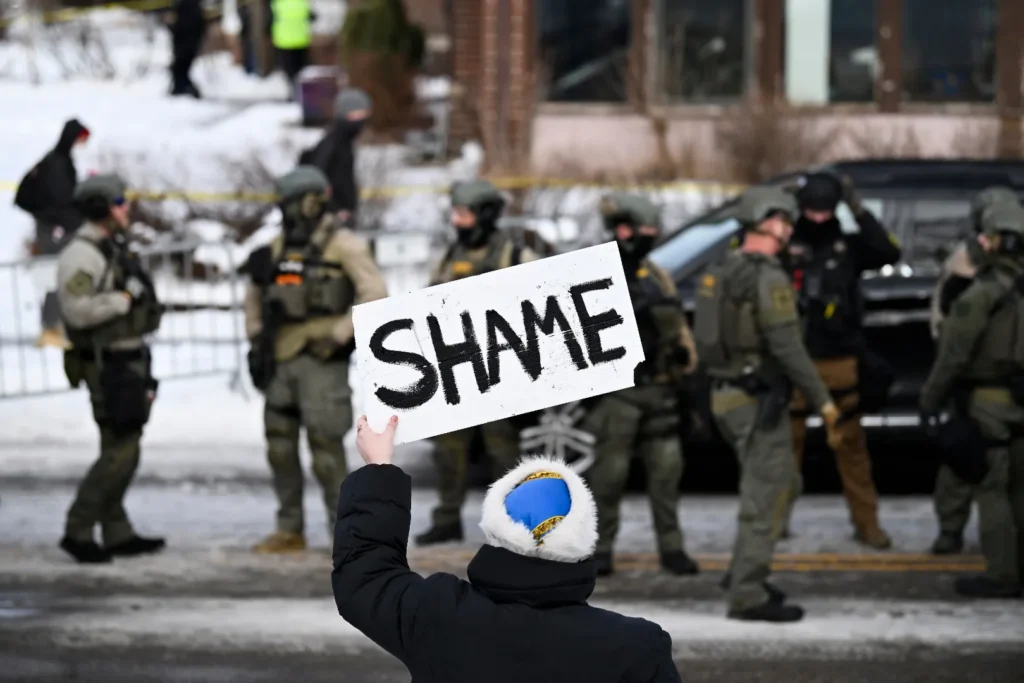
Protests erupted across Minneapolis shortly after the shooting. Demonstrators gathered at the scene, chanted anti-ICE slogans, and formed memorials. Federal officers responded with tear gas and pepperball weapons, detaining several participants.
Schools were closed on Thursday and Friday to anticipate unrest. Religious leaders and civil rights organizations addressed the crowds, emphasizing accountability and calling for reform.
Public Opinion After This Incident
The fatal shooting of Renee Nicole Good by an ICE officer has sparked widespread public concern and debate. Many Americans question the legal powers of ICE officers and the circumstances under which deadly force is used. Local communities, especially immigrant populations, have expressed fear and frustration over federal operations in urban areas.
Key points of public reaction include:
- Majority concern: 53% of Americans believe the Trump administration is overstepping in immigration enforcement.
- Community fear: Residents report carrying proof of citizenship at all times due to anxiety over federal enforcement.
- Protests and activism: Demonstrations erupted in Minneapolis, with citizens and civil rights groups demanding accountability.
- Social media influence: TikTok videos of the shooting and protests amplified public outrage and discussion.
Overall, public opinion highlights deep divisions over immigration enforcement, ICE officers’ use of force, and the balance between federal authority and civil liberties.
Wider Implications
The Minneapolis case highlights the tension between federal authority and state oversight. For immigrant and naturalized communities, the incident has heightened fear and mistrust. Many now carry proof of citizenship at all times, fearing wrongful detention.
Similar incidents involving federal officers have been reported in Portland and Los Angeles, suggesting a broader pattern of conflict between ICE operations and urban communities.


