


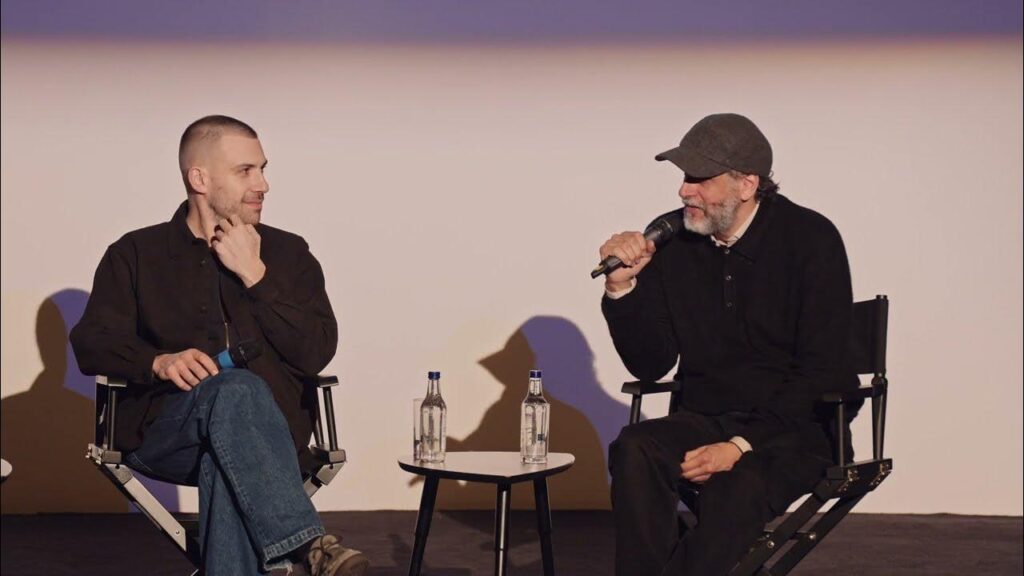
The filmmaker and production designer explore how design and architecture shape the emotional worlds of After the Hunt, Guadagnino’s new drama about cancel culture, and their collaboration with Jonathan Anderson for Dior.
In After the Hunt, Luca Guadagnino’s latest cancel-culture drama, Julia Roberts portrays an Ivy League professor confronted by the ghosts of her past when a colleague faces sexual assault allegations. The film opens with a single line — “It happened at Yale” — instantly setting the tone for a story about power, truth, and memory. Yet despite the reference, the film wasn’t shot in New Haven… According to the Roger Ebert Review of After the Hunt, Luca Guadagnino masterfully examines morality, identity politics, and generational tension — even when his complex storytelling risks emotional distance.
Baisi, an architect and production designer, has been a vital creative partner in Guadagnino’s expanding visual universe. Since joining Studio Luca Guadagnino in 2017, he has moved seamlessly between architecture and film, first collaborating with the director on Queer. That partnership deepened into a shared practice where design becomes narrative — an expressive language shaping character, tension, and emotion.To capture the atmosphere of After the Hunt, Baisi visited New Haven, studying its vernacular architecture — from small landmarks like the Tandoor Indian restaurant to the monolithic Beinecke Library, whose windowless façade embodies both academia and alienation. These details became more than architectural references; they served as metaphors for the film’s inner world. Through his selection of materials, furniture, and textures, Baisi crafted spaces that mirror the characters’ emotional states — fragile, secretive, and searching for self-preservation.
Design is a narrative strategy,” Baisi explains — a guiding idea that defines both his and Guadagnino’s work.
Designing Tension and Truth
Each environment in After the Hunt holds its own psychological charge. Alma (Julia Roberts) lives between two contrasting worlds: the home she shares with her husband Frederik (Michael Stuhlbarg), and a waterfront apartment on Long Wharf where she retreats to write. Both settings tell unspoken stories about identity and repression.
“In [Alma and Frederik’s apartment], we wanted to create three layers of history,” Baisi recalls. “The first belonged to his grandparents — people we imagined as European émigrés carrying the spirit of the Wiener Werkstätte and Bauhaus movements. We designed and recreated furniture inspired by that design experience, giving the apartment a sense of inherited memory.”
As Alma and Frederik inhabit the space, their personalities mingle with this history — and with their secrets. “They hide things and tell lies,” Baisi continues. “That apartment is layered with concealment. The Long Wharf apartment, however, is different — it’s a mental space, where Alma can, in some way, be herself.”
Luca Guadagnino adds, “The infrastructure of those apartments defines Alma’s duality. The waterfront loft she rents to write is a blank canvas, a space of intimacy and solitude. Stefano designed it to reveal her private self — the opposite of her public persona, which dominates the apartment she shares with Frederik. As soon as the viewer enters the space, that tension between performance and authenticity becomes visible.” This layered contrast between private and public identity, often explored in The London Magazine celebrity essays on lifestyle and design, reflects Guadagnino’s fascination with how environments mirror emotion and character.
The Fusion of Architecture and Cinema
Their dialogue underscores how design and cinema intertwine in Guadagnino’s creative philosophy. When asked whether design has become central to his filmmaking, he reflects:
I wouldn’t say design is central to my cinema,” Luca Guadagnino explains. “They’re two distinct disciplines I love deeply. Sometimes they merge naturally, but I approach each with a different mindset and craft. Of course, they’re connected because I’m the same person — but I never want to force that connection.
For Stefano Baisi, entering cinema from architecture opened an entirely new way of seeing. “I was always fascinated by film,” he says. “But I never imagined working in it until Luca asked me. Once I started, I discovered a completely different way to design — one guided by the lens of the camera and the eyes of the characters.”
Guadagnino agrees. “In architecture, you design for a client — for their psychology, their lifestyle, their comfort. In cinema, you design for the story. The space must be truthful to the characters, not to an individual client. It’s a more vulnerable and poetic process.”
Beyond Film – Dior and the Louvre
Their partnership extends well beyond cinema. Recently, Guadagnino and Baisi collaborated with Jonathan Anderson on his womenswear debut for Dior, merging their cinematic sensibility with the theatricality of high fashion. As detailed in Wallpaper’s Feature on Dior’s Womenswear Debut, Luca Guadagnino and Stefano Baisi crafted a scenographic concept featuring an inverted pyramid above the runway. A symbolic nod to the Louvre’s iconic design.
“This was a beautiful invitation,” says Luca Guadagnino. “Jonathan approached us during the summer while we were shooting Artificial, and it became a refreshing creative diversion.”
Baisi recalls feeling “honored to design that space with Luca.” Together, they conceived a set within the Tuileries, across from the Louvre, inspired by the museum’s inverted pyramid — an emblem of both French architecture and contemporary visual culture.
“Jonathan has an amazing brain,” Guadagnino says. “We explored different ideas, and he said, ‘We’re across from the Louvre, one of France’s great symbols is the upside-down pyramid.’ From there, we developed something architectural, almost monumental, a space that felt both museum-like and cinematic.”
The final result fused art, fashion, and architecture into a single narrative space. Filled with Adam Curtis’s moving images, models, and clothing, the set blurred the line between exhibition and performance — echoing the immersive storytelling approach of Guadagnino’s films.
The Architecture of Feeling
Both Luca Guadagnino and Stefano Baisi see design as a medium for empathy. Their collaborations — whether on After the Hunt, Queer, or Dior — treat architecture as an emotional instrument. A windowless library, a stark office, or a loft overlooking the sea can all function as psychological mirrors, revealing inner truths words can’t express. In After the Hunt, design becomes a moral compass. The austerity of the Beinecke Library, the warmth of Alma’s inherited apartment, and the bare openness of the Long Wharf loft each speak to different facets of her character — her intellect, her guilt, her longing for honesty. The film’s production design thus becomes storytelling in its purest form.
I discovered another way to design,” says Baisi. “It’s no longer just about space — it’s about people. You design through the perspective of their emotions.
Guadagnino nods to that idea, adding, “Every surface, every shadow, every wall becomes part of the film’s rhythm. That’s the beauty of cinema — it allows design to breathe as character.”
Interdisciplinary Storytelling
The collaboration between Luca Guadagnino and Stefano Baisi signals a larger shift in visual culture, where disciplines once separated — film, art, fashion, architecture — now converge to form new languages of storytelling. In both After the Hunt and the Dior runway, they craft spaces that transcend the screen or stage, transforming design into an emotional narrative tool.
Their work suggests that architecture is no longer static or decorative — it’s performative, alive, and psychological. In Guadagnino’s cinema, rooms remember, walls confess, and furniture bears the weight of human contradiction.After the Hunt reaches audiences, and the echoes of their Dior collaboration linger across Paris, one thing remains constant: for Luca Guadagnino and Stefano Baisi, design is not background — it’s narrative essence. Whether constructing a professor’s haunted apartment or a monumental fashion set beneath the Louvre’s inverted pyramid, they continue to blur the boundaries between craft and emotion, proving that architecture, like cinema, can tell the most human stories of all.


