


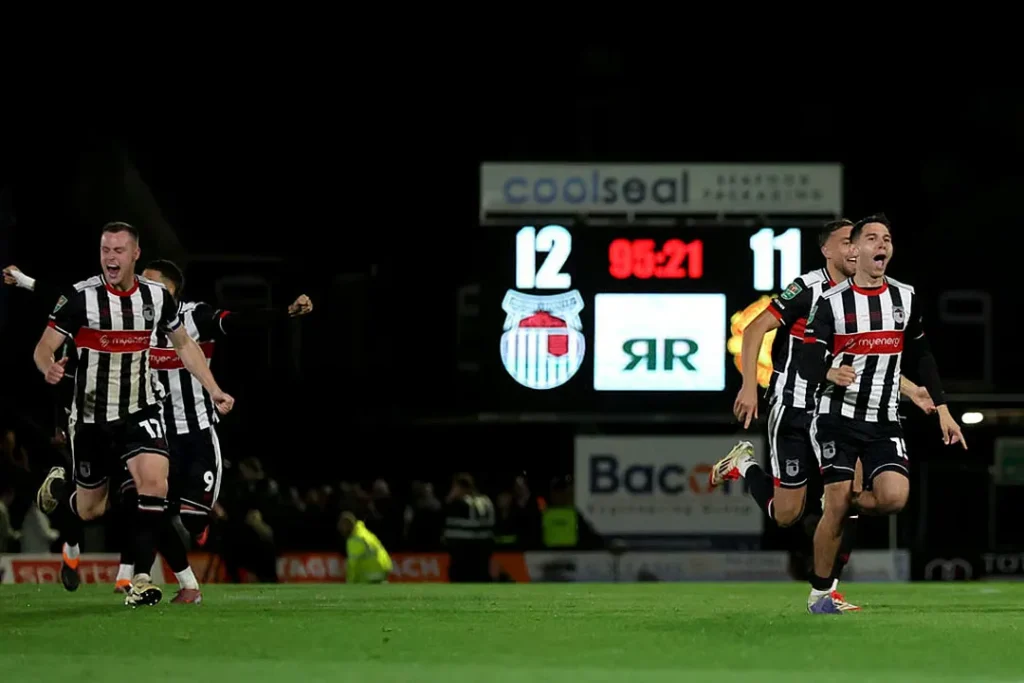
The EFL Cup second round delivered a dramatic upset as Grimsby Town eliminated Manchester United F.C. on penalties at Blundell Park on August 28, 2024. The grimsby town vs manchester united f.c. lineups proved decisive, with tactical rotation and defensive structure shaping the contest. Despite United racing into a 2-0 lead inside 30 minutes, Grimsby responded with an 89th-minute equaliser before winning 12-11 in a marathon shootout. As highlighted by The London Magazine, the result offered a clear tactical blueprint for how lower-league sides can challenge Premier League opposition in domestic cup competition.
Match Overview & Key Details
This EFL Cup second round fixture showcased the unpredictable nature of domestic cup competitions, where tactical preparation and mental fortitude can level the playing field between divisions. Manchester United arrived at Blundell Park with a heavily rotated squad, while Grimsby Town deployed their strongest available lineup in pursuit of a historic result. The grimsby town vs manchester united f.c. lineups revealed contrasting approaches: Erik ten Hag opted for wholesale changes to manage squad workload, while Grimsby manager Paul Hurst fielded a full-strength side with tactical modifications designed to exploit United’s rotation policy.
Match Summary:
- Competition: EFL Cup Second Round
- Venue: Blundell Park, Cleethorpes
- Date: August 28, 2024
- Full-Time Score: 2-2 (after extra time)
- Penalty Score: 12-11 (Grimsby Town won)
- Attendance: 9,052
- First Goal: Manchester United (22′)
- Second Goal: Manchester United (30′)
- Equalizer: Grimsby Town (89′)
The tactical narrative of this encounter shares similarities with other recent cup upsets in English football. Much like the drama documented in our Aston Villa vs Newcastle FA Cup match report, this fixture demonstrated how tactical adjustments and psychological momentum can overcome perceived quality gaps in knockout football.
Confirmed Grimsby Town F.C. Lineup & Formation
Grimsby Town deployed a disciplined 4-1-4-1 formation designed to compact central areas and force Manchester United into wide positions where their rotated squad lacked cohesion. Manager Paul Hurst selected his most experienced players for this high-profile fixture, prioritizing defensive solidity while maintaining counter-attacking threat.
Starting XI (4-1-4-1):
| Position | Player Name | Key Role |
| GK | Jordan Wright | Distribution and penalty hero |
| RB | Harvey Rodgers | Defensive discipline |
| CB | Luke Waterfall | Aerial dominance |
| CB | Doug Tharme | Recovery defending |
| LB | Denver Hume | Progressive passing |
| DM | Gavan Holohan | Defensive screen |
| RM | Kieran Green | Work rate and pressing |
| CM | Donovan Wilson | Box-to-box energy |
| CM | Charles Vernam | Creative link |
| LM | Harry Clifton | Counter-attacking width |
| ST | Danny Rose | Target man hold-up play |
Tactical Setup & Player Roles
The grimsby town vs manchester united f.c. lineups comparison revealed Grimsby’s intelligent tactical setup focused on limiting space between defensive and midfield lines. Gavan Holohan’s positioning as the defensive midfielder proved crucial, screening the back four and disrupting United’s attempts to play through central areas. The wide midfielders Kieran Green and Harry Clifton maintained disciplined positions, rarely venturing ahead of the ball in the first half to prevent counter-attacking exposure.
Danny Rose’s role as the lone striker required exceptional physical endurance and intelligent movement. His hold-up play provided the foundation for Grimsby’s counter-attacks, while his tireless pressing forced errors from United’s inexperienced defenders. The tactical approach demonstrated sophisticated match preparation, with Grimsby’s coaching staff clearly identifying vulnerabilities in United’s rotated backline.
Confirmed Manchester United F.C. Lineup & Formation
Manchester United manager Erik ten Hag implemented a 3-4-2-1 formation featuring nine changes from the previous Premier League fixture. This tactical system aimed to provide defensive stability through three center-backs while offering attacking width through wing-backs. However, the lack of familiarity between rotated players created cohesion issues that Grimsby exploited in the second half.
Starting XI (3-4-2-1):
| Position | Player Name | Competition Debut/Rotation |
| GK | Altay Bayındır | First EFL Cup start |
| CB | Harry Maguire | Rotation opportunity |
| CB | Jonny Evans | Experience anchor |
| CB | Victor Lindelöf | Left-sided center-back |
| RWB | Diogo Dalot | Attacking outlet |
| CM | Casemiro | Midfield leadership |
| CM | Christian Eriksen | Creative distribution |
| LWB | Tyrell Malacia | First start of season |
| CAM | Bruno Fernandes | Captain and playmaker |
| CAM | Antony | Goal threat |
| ST | Marcus Rashford | Pace and finishing |
Tactical Setup & Rotation Analysis
The grimsby town vs manchester united f.c. lineups showed how Manchester United’s rotation created both opportunities and risks. Their 3-4-2-1 system aimed to control central areas, with Casemiro and Christian Eriksen managing possession and Bruno Fernandes and Antony operating between the lines. Marcus Rashford led the attack to exploit space against Grimsby’s compact defensive block. However, the back three of Maguire, Evans, and Lindelöf struggled with transitions, while Bayındır’s limited match rhythm and Malacia’s rust exposed the flanks. Early goals masked these weaknesses, which became clear as Grimsby grew into the match.
Key Substitutions & Game-Changing Moments
Substitutions had a decisive impact. Manchester United brought on Alejandro Garnacho, Mason Mount, and Joshua Zirkzee between the 60th and 75th minutes to boost attack, but defensive frailties remained. Grimsby’s changes were more effective: Luca Barrington added direct running, Jayden Luker refreshed the wide areas, and Jordan Davies played a key role in the 89th-minute equalizer. These moves exploited United’s tired and rotated players, shifting momentum in favor of Grimsby and setting the stage for extra time and the dramatic penalty shootout.
Match Statistics Comparison
The statistical analysis reveals how Grimsby’s tactical discipline neutralized Manchester United’s technical superiority. While United dominated possession and shot count, the quality of chances remained relatively equal, particularly after halftime adjustments.
| Statistic | Grimsby Town | Manchester United |
| Possession | 37% | 63% |
| Total Shots | 11 | 18 |
| Shots on Target | 6 | 7 |
| Corners | 4 | 9 |
| Fouls Committed | 14 | 8 |
| Pass Completion | 68% | 81% |
| Goals Scored | 2 | 2 |
| Penalty Conversion | 12/12 | 11/12 |
The possession differential reflects the expected pattern given the divisional gap, yet Grimsby’s efficiency in transition created genuine scoring opportunities. The shots on target statistic demonstrates clinical finishing from both sides within the run of play, while the penalty shootout statistics reveal exceptional nerve from Grimsby’s players under immense pressure. The foul count indicates Grimsby’s physical approach disrupted United’s rhythm without crossing into reckless territory.
Tactical Breakdown – Why the Result Happened
The result stemmed from several tactical factors over 120 minutes. Manchester United started strong as Grimsby opened cautiously, allowing space for their technical players to exploit. The 22nd and 30th-minute goals came from individual errors rather than systemic flaws, giving United a false sense of control.
At halftime, Grimsby’s coaching staff adjusted pressing triggers, shifting from passive defending to aggressively engaging United’s center-backs. This disrupted build-up play and allowed Grimsby’s fresher defenders to exploit space. The grimsby town vs manchester united f.c. lineups highlighted United’s lack of defensive security under sustained pressure.
Manchester United’s continued use of the 3-4-2-1 system, combined with attack-focused substitutions, left wing-backs exposed. Grimsby capitalized with their late equalizer, showcasing how tactical discipline and rotation awareness can overcome higher-quality opposition. As noted by The London Magazine, these moments underscore the risks of rotation policies that compromise squad cohesion in knockout competitions.
Player Performances & Standout Statistics
Individual performances ultimately decided this dramatic encounter, with several players exceeding expectations under pressure. For Grimsby Town, goalkeeper Jordan Wright delivered a masterclass in penalty psychology, saving the decisive spot-kick after 23 successful conversions. His positioning and timing demonstrated professional-level technique that belied his League Two status.
Danny Rose’s physical performance statistics highlighted his importance to Grimsby’s tactical plan. The striker contested 18 aerial duels, winning 11, while completing 23 passes with 65% accuracy despite constant defensive attention. His tireless running forced Manchester United’s center-backs into uncomfortable positions throughout the match, creating the space for teammates to exploit in transition.
For Manchester United, Bruno Fernandes’ creative statistics showed individual quality that couldn’t translate into team success. The captain created five chances, completed 89% of his passes, and maintained constant movement between lines. However, the grimsby town vs manchester united f.c. lineups revealed limited support from less experienced teammates unable to match his intensity and decision-making quality over 120 minutes.
Marcus Rashford’s finishing secured United’s early advantage, but his 31 touches over 120 minutes illustrated the service issues created by disjointed team performance. The striker’s isolation reflected broader tactical problems that Grimsby’s compact defensive structure exploited effectively. The contrast between individual brilliance and collective dysfunction ultimately determined Manchester United’s elimination.
Squad Depth Comparison
The broader squad context explains why rotation policies carry inherent risks in cup competitions. The depth comparison reveals significant differences in experience and international pedigree between the two squads.
| Category | Grimsby Town | Manchester United |
| Average Squad Age | 26.3 years | 25.8 years |
| International Players | 2 | 18 |
| Foreign Players | 4 | 21 |
| Average Market Value | £1.2M | £42M |
| League Position (Previous Season) | 19th (League Two) | 8th (Premier League) |
Despite the massive financial disparity, Grimsby’s squad cohesion and match rhythm advantages proved decisive. The home side fielded players with consistent minutes and established on-field relationships, while United’s rotated lineup lacked the familiarity required for complex tactical execution under pressure. The analysis of grimsby town vs manchester united f.c. lineups demonstrate how squad harmony can temporarily overcome individual quality gaps in knockout football environments.
What This Result Means Going Forward
For Grimsby Town, this win brings financial reward, confidence, and validation of their tactical discipline. Beating higher-level opposition proves their structure and preparation can compete beyond League Two.
For Manchester United, the defeat exposes concerns about rotation balance and squad cohesion. Heavy changes disrupted defensive organisation, and the lack of chemistry proved costly in a knockout setting.
Mentally, Grimsby gained momentum for the rest of their season. United’s fringe players, meanwhile, missed a key opportunity to strengthen their first-team credentials.
Conclusion
The grimsby town vs manchester united f.c. lineups highlighted how organisation can overcome individual quality. United’s rotated side lacked defensive stability, while Grimsby’s compact 4-1-4-1 system delivered structure, resilience, and clinical execution when it mattered. The penalty shootout reflected superior composure from the home side, turning belief into a historic result. For Manchester United, this EFL Cup exit is a reminder that depth alone is not enough in knockout football — cohesion, tactical clarity, and mental sharpness remain decisive.
Frequently Asked Questions
What formation did Grimsby Town use against Manchester United in the EFL Cup?
Grimsby Town deployed a disciplined 4-1-4-1 formation with Gavan Holohan as the defensive midfielder, prioritizing defensive compactness and quick counter-attacks against United’s rotated lineup.
Why did Manchester United lose to Grimsby Town despite leading 2-0?
Manchester United’s extensive squad rotation created defensive vulnerabilities and poor team cohesion. The inexperienced backline struggled with Grimsby’s second-half pressing, ultimately conceding a late equalizer.
Who scored the goals in the Grimsby Town vs Manchester United match?
Manchester United scored twice in the first half (22nd and 30th minutes). Grimsby equalized dramatically in the 89th minute, forcing extra time and winning 12-11 on penalties.
How many penalties were taken in the Grimsby Town vs Manchester United shootout?
The penalty shootout required 24 total kicks, with Grimsby winning 12-11. Jordan Wright saved Manchester United’s 12th penalty after both teams converted their first 11 attempts.
What tactical changes did Grimsby Town make at halftime to improve performance?
Grimsby adjusted their pressing triggers to engage United’s center-backs higher up the pitch, disrupting build-up play and forcing defensive errors from the rotated backline throughout the second half.


